
Sustainability & impact · for NGOs, DFIs, donors and buyers
Seaweed processing sustainability, engineered into the equipment
We build the seaweed processing machines and plants that let coastal producers use the whole biomass, trace every batch and keep the value at home. We do not grow or sell seaweed ourselves.
Total utilisation · traceability · local value retention · resource-matched capacity
Four commitments in seaweed processing — and the mechanism behind each
Total biomass utilisation by design
70–85% of the seaweed feedstock leaves a conventional hydrocolloid plant as residue or effluent; only 15–30% becomes product. Our seaweed processing lines are laid out so every stream has a destination: press liquid to biostimulant or extract, press cake to fibre, feed or dried input, wash water recycled or treated — more product per tonne, less to discard.
Seaweed traceability engineered in
Our equipment makes your ingredients traceable: batch identification from intake, and — with the PLC & automation option (PLC: the plant control system) — logged process data (temperatures, times, throughput), plus operator SOPs and QA points that map onto HACCP-style food-safety control. Evidence a buyer or certifier can audit.
Local value retention
Modules are deployed close to the biomass and owned by the community, cooperative or local operator. Sirputis engineers, builds and trains — the jobs, the product and the margin stay on the coast.
Capacity matched to the seaweed resource
Every programme is sized to the resource assessment before a machine is specified — standing biomass, sustainable harvest fraction, regrowth time — using the Sirputis biorefinery design tool. Capacity is set by the arithmetic, not by ambition.
Sources: Liu et al. 2024, Comprehensive Reviews in Food Science and Food Safety — 15–30% utilisation of hydrocolloid feedstock, 70–85% discarded (doi:10.1111/1541-4337.70027); European alginate industry discards ≈ 80% of algal biomass as residual streams (Sci. Total Environ. 2022).
Sized within the seaweed resource — a worked example (Norwegian kelp)
- 01
Standing biomass
Norway's Laminaria hyperborea forests hold about 60 million tonnes. - 02
Regulated harvest
150,000–180,000 tonnes are harvested per year, 0.25–0.30% of the standing stock (Vea & Ask 2011; the Norwegian Blue Forests Network cites 120,000–180,000 tonnes). Harvesting is managed by the Directorate of Fisheries, and harvested fields regrow in 3–5 years. - 03
What one plant takes
If a 6,000 t/y plant — the design capacity of our largest reference lines — were fed entirely from this wild harvest, it would take 3.3–4% of the annual harvest and 0.01% of the standing stock. The programme is sized to the resource, never the other way round.
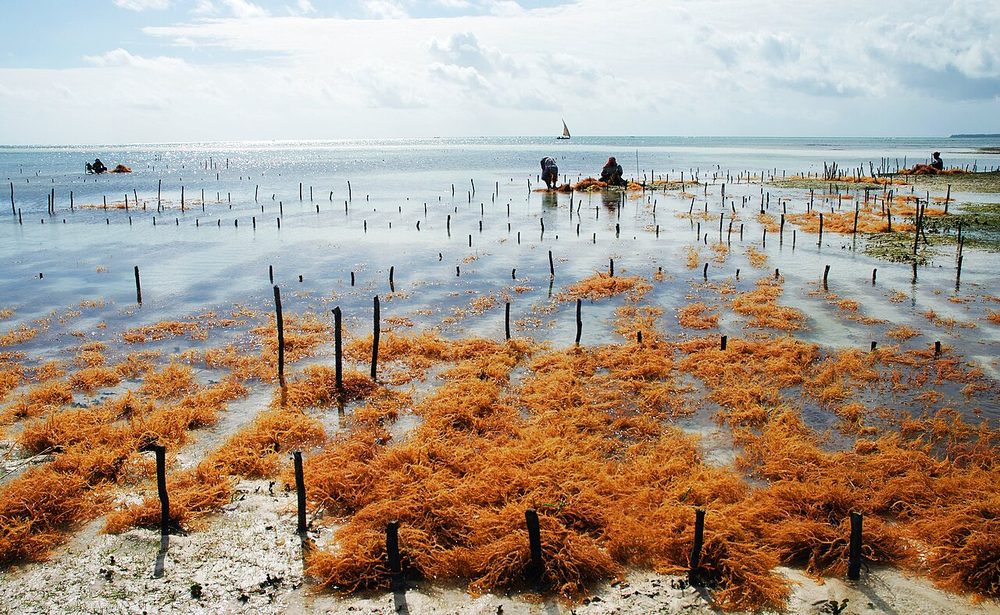
Sources: Vea & Ask 2011, Journal of Applied Phycology (doi:10.1007/s10811-010-9610-y); Norwegian Blue Forests Network, The Kelp Industry brief. Photo: Uroa, Zanzibar, Tanzania. For cultivated or beach-cast biomass the same three lines are computed per site in the programme feasibility stage.
UN Sustainable Development Goals — mapped per seaweed programme
Six goals, one mechanism sentence each, written so a programme officer can lift it into an approval memo. We do not claim the other eleven.
SDG 14Life below water
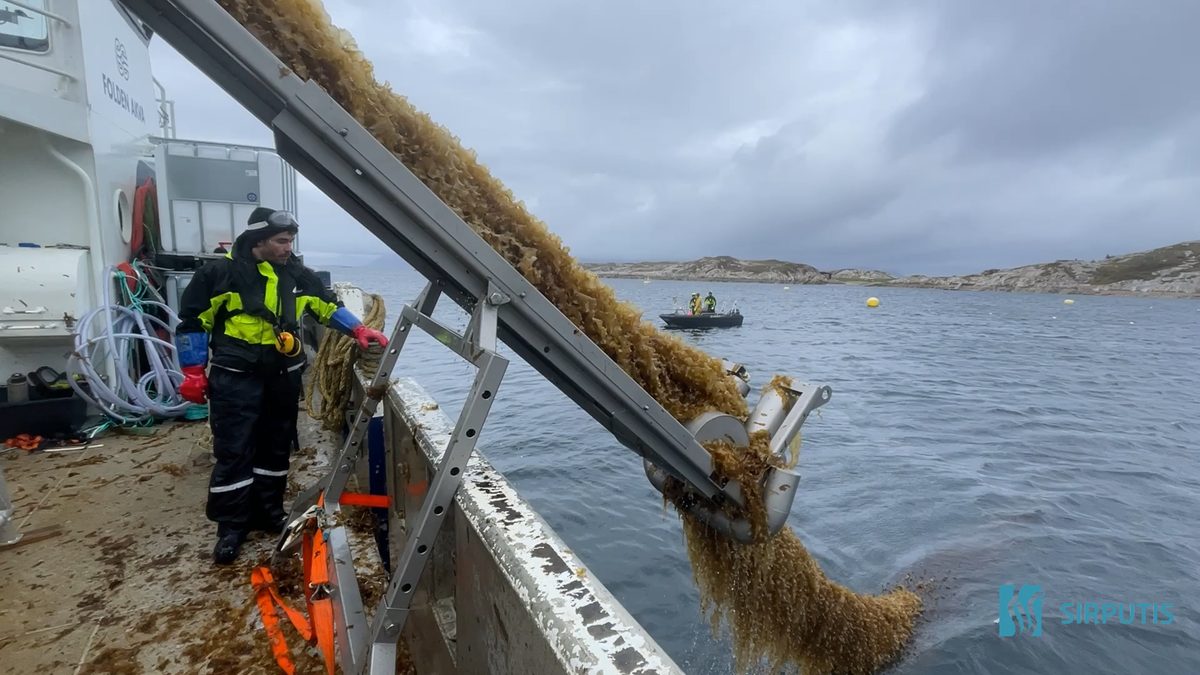
On cultivated lines, blade-free water-jet harvesting preserves the holdfast for regrowth (02 BlueHarvest Launchpad, 03 Ocean Circular Hub); in every programme, capacity is capped by the site resource assessment.SDG 8Decent work & growth
Local operators are trained in SOPs, QA and maintenance and run the plant themselves (02 BlueHarvest Launchpad, 03 Ocean Circular Hub).SDG 9Industry & infrastructure
Modular processing infrastructure deployed close to biomass in 12–24 months, in stages rather than a multi-year greenfield build — replicable across coasts (03 Ocean Circular Hub).SDG 12Responsible production
Lines designed for whole-biomass use — press cake, liquid fraction and wash water each have a route; discards are designed out (02 BlueHarvest Launchpad, 03 Ocean Circular Hub).SDG 13Climate action
Seaweed is a low-input crop — no freshwater, fertiliser or arable land — and local processing cuts the transport of wet biomass (01 SeaValue Catalyst sets the pathway).SDG 5Gender equality
Programmes can be scoped for women- and youth-led seaweed enterprises, where much of the world's coastal seaweed farming already happens (02 BlueHarvest Launchpad).How we measure seaweed processing impact
Impact claims are only useful to a funder if they can be measured after commissioning. Every Sirputis programme therefore reports four numbers, defined before the first machine is specified:
- Utilisation — the share of intake biomass that leaves as product (target set per route; conventional hydrocolloid plants sit at 15–30%).
- Batches logged — the share of production batches with a complete intake-to-dispatch record (100% with the PLC & automation option).
- Local jobs and training — operators trained and certified on SOPs, by role and gender.
- Capacity within the resource — plant throughput as a share of the site's assessed sustainable harvest, capped in the programme design.
Funders ask the same three questions in every ESG questionnaire, so here are the short answers:
Is the equipment certified? Machinery for the EU market is delivered with a declaration of conformity and technical file; a sample is available on request.
Who owns the data? The plant owner. Process data logged by the control system stays with the owner; Sirputis accesses it for remote support only with consent.
What about the supply chain? Short and known: stainless fabrication in Šiauliai, European component suppliers, EU-law transport partners, an anti-slavery clause in every contract (general terms, §4). The full statement is in signature (Q4 2026).
Documents for procurement & ESG questionnaires
| Document | Status | Action |
|---|---|---|
| Declarations of conformity and technical documentation — supplied per machine with the delivery documentation, as required for machinery placed on the EU market | Per delivery | Request a sample declaration of conformity |
| Responsible business & supply-chain statement (anti-slavery, supplier standards, materials, data) | In signature · available Q4 2026 | Notify me |
| General terms — materials (AISI 316/L product-contact, 304/L non-contact), 2-year corrosion guarantee, anti-slavery clause (§4) | Current · issued with every quotation | Request a quotation |
| Grant & project register — agreement numbers, budgets, public support | Sep 2026 | Open the grant & project register |
Writing a funding memo or an ESG questionnaire?
Send us the template. We answer with equipment-level evidence — utilisation design, traceability features, resource arithmetic and the SDG mapping above — not marketing copy.