
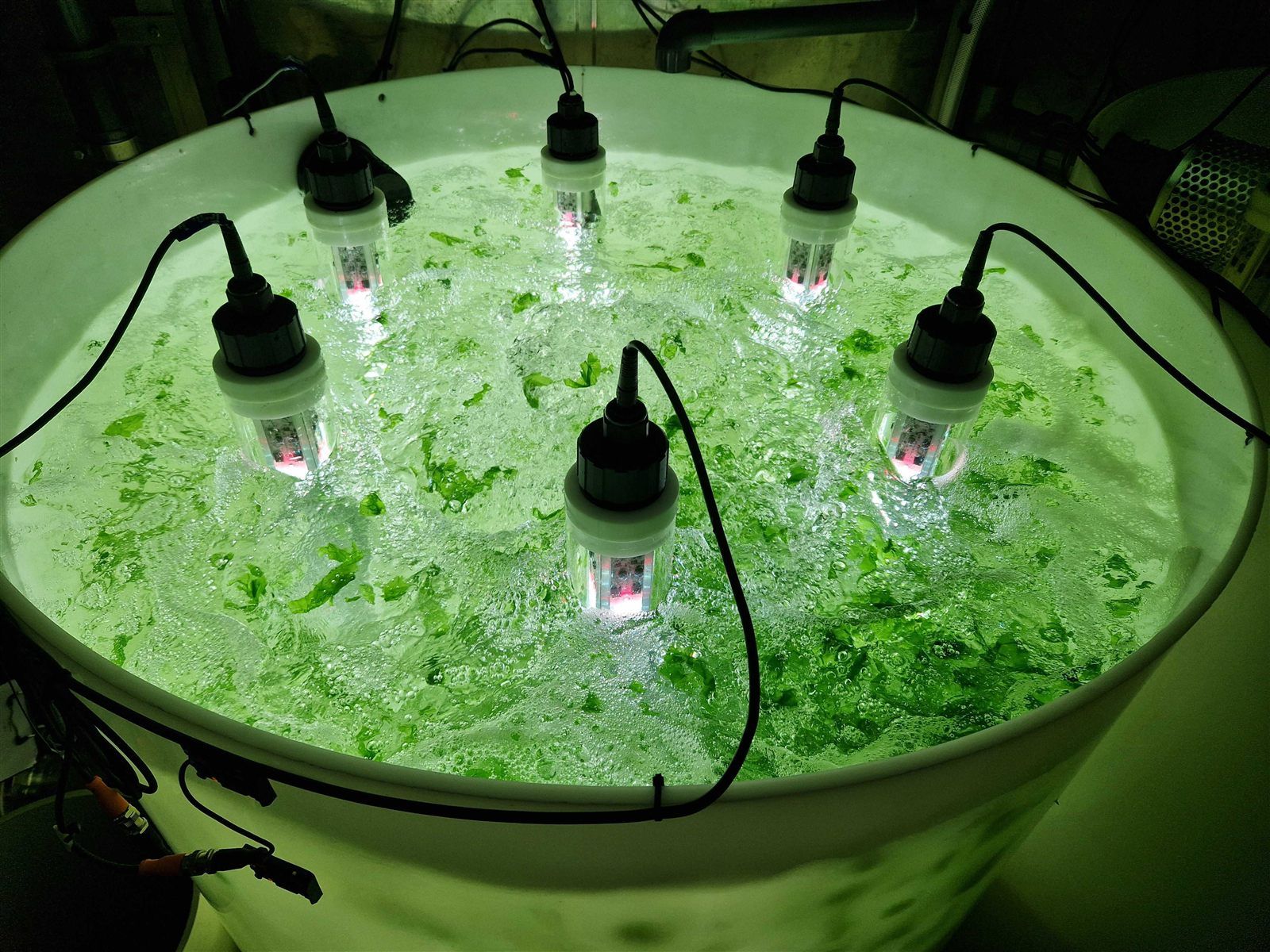
Photo: Ulva in a VALUEFARM photobioreactor (2023)
Land-based seaweed farming · SIRPUTIS, technology partner of Pure Algae, Denmark
Land-based seaweed farming: the VALUEFARM container
Grow Ulva (sea lettuce) on land, all year, in Pure Algae's 40 ft VALUEFARM container with eight photobioreactors. It runs stand-alone or on nutrient-rich water from a land-based fish farm.
40 ft High Cube reefer · 8 PBRs x 1,200 L = 9,600 L · up to 5.4 t fresh Ulva per year (Pure Algae data, high-performing strain, optimal conditions)
Land-based seaweed farming means growing seaweed in controlled tanks on land instead of at sea. VALUEFARM, developed by Pure Algae in Grenaa, Denmark, does this in a 40 ft container that can run on nutrient-rich water from a salmon or other RAS fish farm and turn part of the nitrogen and phosphorus in it into Ulva biomass. SIRPUTIS and Pure Algae work together on VALUEFARM in a strategic technology partnership: Pure Algae owns VALUEFARM and signs the customer contract, and SIRPUTIS is Pure Algae's technology partner for engineering and downstream processing equipment and the first contact for enquiries. As of November 2026, one 40 ft VALUEFARM unit is available.
9,600 Lcultivation volume: 8 photobioreactors x 1,200 L
5 to 13 kgfresh biomass per photobioreactor per week (Pure Algae data, optimal conditions)
5.4 t/yrmaximum fresh Ulva output per container (Pure Algae data, high-performing strain, optimal conditions)
24/7controlled environment, independent of wind and weather
What is the VALUEFARM container?
VALUEFARM is a compact, containerised seaweed cultivation system developed by Pure Algae Denmark. The 40 ft version is built into an insulated High Cube reefer container and holds eight photobioreactors (PBRs) of 1,200 L each for Ulva cultivation: 9,600 L of cultivation volume in total.
A photobioreactor (PBR) is a lit and aerated tank in which seaweed grows under controlled conditions, unlike open ponds or ropes at sea.
Light, temperature and water flow are controlled inside the container, so production runs 24/7 and does not depend on wind, weather or season. The unit works stand-alone or integrated with a recirculating aquaculture system (RAS). Pure Algae calls the RAS-integrated mode IMRAS (integrated multi-trophic RAS).
Typical uses are commercial production, a reliable biomass supply, biotech, seaweed grow-out and research. Pure Algae also offers a 20 ft version with three photobioreactors (3,600 L).
Built into the 40 ft unit (Pure Algae specification)
- Eight photobioreactors of 1,200 L
- Integrated harvesting system with tanks and pumps
- Integrated seaweed pressing unit
- Flow-through system and plug-and-play connection hub
- Sensors and monitoring
- Optional IoT monitoring of temperature, pH, flow, salinity and biomass growth
How does a seaweed farming container work?
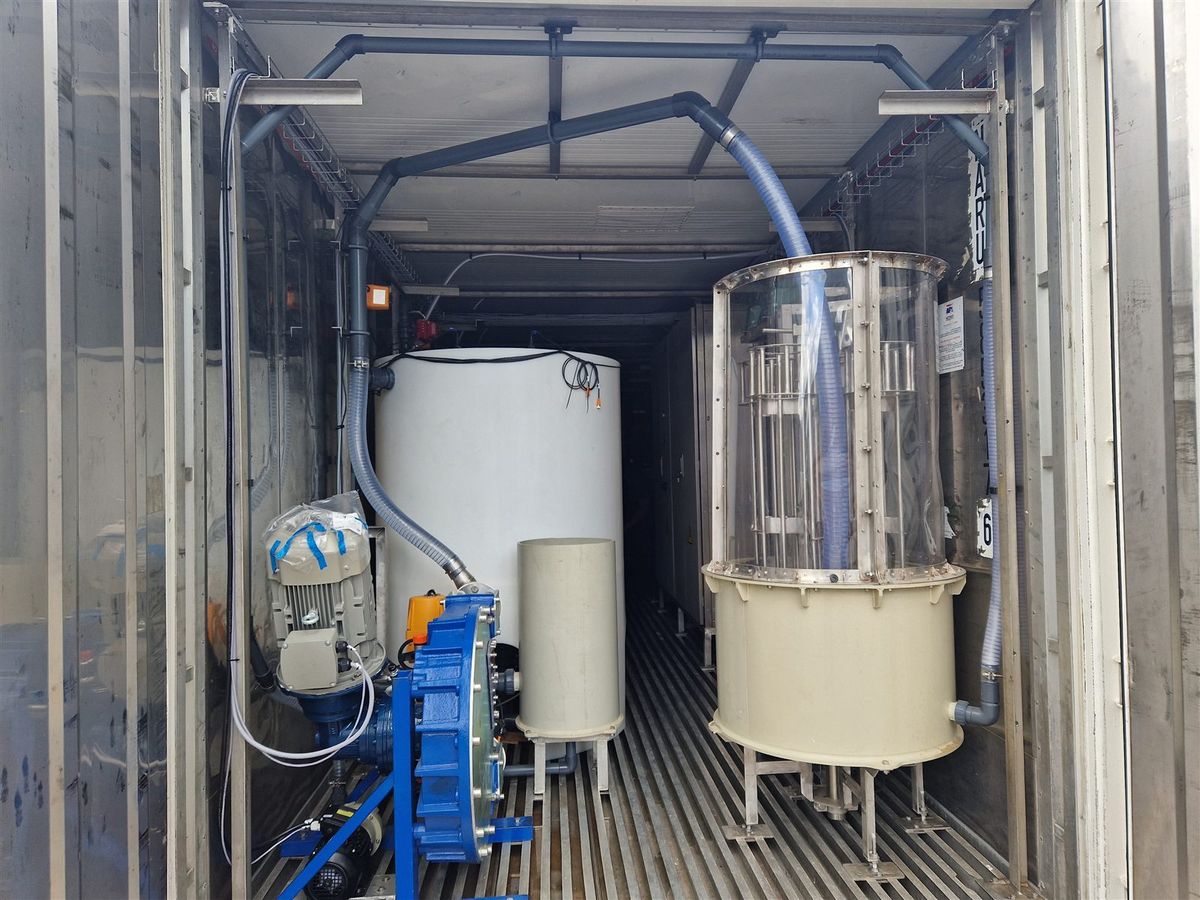
Photo: inside a 40 ft VALUEFARM container (2023)
- 01
Water in
Seawater, or process water from a fish farm, is connected through the plug-and-play hub and flows through the system. - 02
Growth
Ulva grows in eight 1,200 L photobioreactors that are lit, aerated and kept under controlled conditions around the clock. Sensors follow the water and the growth. - 03
Harvest
The integrated harvesting system, with its own tanks and pumps, takes the grown seaweed out of the reactors. - 04
Pressing
Pure Algae's integrated pressing unit removes water from the fresh biomass, so it is ready for use or for further processing. - 05
Processing
Downstream, SIRPUTIS processing equipment can wash and dewater, dry and mill the harvest, or feed it into a processing line.
What does a 40 ft VALUEFARM container hold and produce?
The figures below are Pure Algae's published specification of its current 40 ft VALUEFARM container. Output figures apply under optimal conditions; real output depends on the strain, water quality, temperature and how the unit is run. The equipment list for a specific unit is confirmed in the offer.
| Container | 40 ft High Cube reefer (insulated) |
|---|---|
| Cultivation volume | 8 photobioreactors (PBRs) x 1,200 L = 9,600 L |
| Output per PBR | 5 to 13 kg fresh biomass per week, at about 10% dry weight (Pure Algae range, optimal conditions) |
| Output per container | Up to 5.4 t fresh Ulva per year for a high-performing strain (Pure Algae data, optimal conditions) |
| Species | Ulva (sea lettuce) |
| Harvest and pressing | Integrated harvesting system with tanks and pumps; integrated seaweed pressing unit |
| Water connection | Flow-through system; plug-and-play connection hub |
| Monitoring | Sensors and monitoring; IoT monitoring optional |
| Environment | Controlled 24/7, independent of wind and weather |
| Operation | Stand-alone, or integrated with RAS fish farms (IMRAS) |
| Applications | Commercial production, reliable biomass supply, biotech, seaweed grow-out and research |
How the 5.4 t figure is built: 8 PBRs x 13 kg x 52 weeks is about 5.4 t of fresh Ulva per year. At the low end of the published range, 8 x 5 kg x 52 weeks gives about 2.1 t. At about 10% dry weight, 5.4 t fresh is about 0.54 t of dry matter. Source: Pure Algae, VALUEFARM Containers.
Can seaweed be grown on salmon and RAS fish-farm water?
Yes. Process water from a land-based fish farm carries dissolved nitrogen (N) and phosphorus (P) from feed and fish waste. Seaweed such as Ulva takes up these nutrients as it grows, so part of what would leave the farm in its discharge water becomes biomass instead.
Growing seaweed on fish-farm water in this way, an extractive species on the nutrients of a fed species, is called integrated multi-trophic aquaculture (IMTA). Pure Algae's VALUEFARM container is designed to work integrated with RAS fish farms or stand-alone.
For the fish farm this can mean an extra product line: seaweed that can be processed and sold, for example into food, feed or biostimulant products. Whether it pays depends on the site, the volume grown, the processing route and a buyer for the biomass. SIRPUTIS works this out per project and does not publish generic income figures.
A good fit when
- the farm runs RAS with salt or brackish process water (Ulva is a marine seaweed, so the water must suit Ulva and site water data is reviewed first)
- nutrient discharge is limited by a permit, or the farm reports on nitrogen and phosphorus
- the farm wants a second product from the same water
- there is a plan for the biomass after harvest: processing and a buyer
More on how seaweed processing supports sustainability: sustainability and impact.
Who does what in the Pure Algae and SIRPUTIS partnership?
Pure Algae owns VALUEFARM, holds the patents on its cultivation technology and is the contract partner for VALUEFARM units. SIRPUTIS is Pure Algae's technology partner: it brings engineering and the downstream processing equipment that turns the harvest into a product, and it is the first contact for enquiries.
Pure Algae, Grenaa, Denmark
Cultivation technology and contract partner
- Developed VALUEFARM and holds the patents on its cultivation technology
- Cultivation biology: strain selection and growing know-how for Ulva
- System concept: photobioreactors, harvesting, pressing and monitoring
- Signs the customer contract for VALUEFARM units
- Feasibility studies for new sites
- Also offers VALUEFARM Towers for industrial volumes
SIRPUTIS, Šiauliai, Lithuania
Technology partner: engineering and downstream processing
- Engineering of the processing side of land-based seaweed projects
- Design and build of downstream processing equipment: washing, screw-press dewatering, drying and milling
- Scale-up of processing, from container biomass to a complete processing line
- R&D interest in processing land-grown seaweed and in integrated land-based fish and seaweed systems
- First contact for VALUEFARM enquiries, including the unit available as of November 2026
VALUEFARM is a product name of Pure Algae Denmark. Product questions can also go to Pure Algae directly at contact@purealgae.dk. Read more about our partners and research network.
What happens to the seaweed after harvest?
A container grows biomass; a sellable product needs processing. Fresh seaweed is perishable, so most routes start with washing and dewatering, followed by stabilisation through drying. Further refining, such as extraction, belongs to a biorefinery line.
Washing and dewatering
Washing, shredding and screw-press dewatering for wet seaweed straight from harvest.
Drying and milling
Low-temperature drying, grinding and milling to a stable product that can be stored and shipped.
Biostimulant routes
Equipment for liquid seaweed extracts and biostimulant products. The fit for Ulva is assessed per project.
Complete processing lines
From container biomass to a processing line, sized to the volume a site actually grows.
Is a VALUEFARM unit available?
Yes. As of November 2026, one 40 ft VALUEFARM unit is available. It will be refurbished and configured to the buyer's needs before delivery. The contract is with Pure Algae; SIRPUTIS, as Pure Algae's technology partner, is your first contact.
- Status
- Available as of November 2026
- Unit
- 40 ft VALUEFARM container, High Cube reefer
- Cultivation
- 8 photobioreactors x 1,200 L (9,600 L)
- Species
- Ulva (sea lettuce)
- Condition
- Refurbished and configured to the buyer's needs before delivery
- Equipment list
- Confirmed in the offer
- Contract
- With Pure Algae; SIRPUTIS is technology partner and first contact
- Suits
- Fish farms, research institutes, biotech and seaweed grow-out
Who can work with SIRPUTIS on land-based seaweed R&D?
SIRPUTIS wants to work with universities, research institutes and fish farms on two topics:
- Processing of Ulva and dulse (Palmaria palmata): washing, dewatering, drying and further refining of seaweed grown on land.
- Integrated land-based fish and seaweed systems: how fish farming and seaweed cultivation can share water and nutrients.
Pure Algae's VALUEFARM container is documented for Ulva. Dulse is an R&D interest for SIRPUTIS, not a proven VALUEFARM species.
If you have a project idea or are preparing a joint proposal, write to sales@sirputis.com with a short description, and we will discuss scope and roles with you.
Questions buyers ask about land-based seaweed farming
What is land-based seaweed farming?
Land-based seaweed farming grows seaweed in tanks or photobioreactors on land instead of on ropes at sea. Light, temperature, water flow and nutrients are controlled, so production does not depend on weather or season and can run all year. Pure Algae's VALUEFARM container (Denmark) is one example: a 40 ft unit with eight 1,200 L photobioreactors for growing Ulva (sea lettuce).
Can you grow seaweed in a shipping container?
Yes. Pure Algae's VALUEFARM container is a 40 ft High Cube reefer fitted with eight photobioreactors of 1,200 L each, 9,600 L in total, plus a harvesting system with tanks and pumps, a seaweed pressing unit, and sensors and monitoring, with IoT monitoring as an option. The insulated container keeps a controlled environment around the clock. It runs stand-alone or integrated with a fish farm's RAS.
How much Ulva can a 40 ft VALUEFARM container produce?
Pure Algae, the Danish developer of VALUEFARM, publishes up to 5.4 tonnes of fresh Ulva per year for a 40 ft container with a high-performing strain under optimal conditions. That is eight photobioreactors at up to 13 kg of fresh biomass each per week, at about 10% dry weight. At the low end of the published 5 to 13 kg weekly range, the same arithmetic gives about 2.1 tonnes.
Can seaweed be grown on water from a salmon or RAS fish farm?
Yes. Process water from a land-based fish farm carries dissolved nitrogen and phosphorus from feed and fish waste, and seaweed such as Ulva takes up part of these nutrients as it grows. Growing seaweed on fish-farm water is a form of integrated multi-trophic aquaculture (IMTA). Pure Algae's VALUEFARM container works integrated with RAS fish farms, which Pure Algae calls IMRAS, or stand-alone.
Can seaweed give a land-based fish farm an extra product line?
It can. Part of the nutrients that would otherwise leave the farm in its discharge water can become seaweed biomass that is processed and sold, for example into food, feed or biostimulant products. Whether it pays depends on the site, the volume grown, the processing route and a buyer for the biomass, so SIRPUTIS works this out per project and does not quote generic income figures.
Which seaweed species does VALUEFARM grow?
Pure Algae's VALUEFARM container is documented for Ulva, also called sea lettuce, a fast-growing green seaweed that grows free-floating in lit, aerated tanks. Pure Algae publishes its VALUEFARM output figures for a high-performing Ulva strain under optimal conditions, so Ulva is the species to plan with for a VALUEFARM unit.
Who makes and supplies the VALUEFARM container, and what does SIRPUTIS do?
Pure Algae Denmark (Grenaa, Denmark) develops and supplies VALUEFARM, holds the patents on its cultivation technology and signs the customer contract for VALUEFARM units. SIRPUTIS (Šiauliai, Lithuania) is Pure Algae's technology partner: it designs and builds downstream processing equipment for the harvest, such as washing, dewatering, drying and milling, helps buyers scale up to a processing line and is the first contact for enquiries.
What equipment is needed to process Ulva after harvest?
After harvest, Ulva is usually washed and dewatered or pressed, then used fresh, stabilised by drying, or milled to a powder. Further steps such as extraction belong to a biorefinery line. SIRPUTIS designs and builds this downstream processing equipment, from washing, screw-press dewatering, drying and milling to complete processing lines, sized to the volume a site actually grows.
Is a VALUEFARM container available?
Yes. As of November 2026, one 40 ft VALUEFARM unit is available. It will be refurbished and configured to the buyer's needs before delivery, and the equipment list is confirmed in the offer. The contract is with Pure Algae; SIRPUTIS, as Pure Algae's technology partner, is the first contact: use the request-a-quote form, book a 20-minute call or email sales@sirputis.com.
Can universities, research institutes and fish farms work with SIRPUTIS on land-based seaweed?
Yes. SIRPUTIS is looking for research partners and fish farms to work with on two topics: processing of Ulva and dulse after harvest, and integrated land-based systems that combine fish farming with seaweed cultivation. Universities, research institutes and fish farms with a project idea can write to sales@sirputis.com to discuss scope and roles.
Talk to us about land-based seaweed farming
Tell us about your site, your water and what you want to do with the seaweed, and we will suggest a practical next step. As Pure Algae's technology partner, SIRPUTIS is the first contact for VALUEFARM enquiries.
Email sales@sirputis.com or use the buttons below.
Related reading: modular seaweed biorefinery guide · the global seaweed value chain · sea-based seaweed cultivation equipment · partners and research · seaweed processing FAQ · sustainability and impact
Sources: product data and output figures from Pure Algae, VALUEFARM Containers (checked 12 Nov 2026). Output figures apply under optimal conditions. VALUEFARM is a product name of Pure Algae Denmark. Page updated 12 Nov 2026.