
The global seaweed value chain
From cultivation to buyer-ready products, and the worldwide ecosystem of research, networks, standards and capital around it. A neutral map of the industry, with the sources behind every number.
Compiled by SIRPUTIS · last updated 26 September 2026
Seaweed is one of the fastest-growing parts of world aquaculture, yet it remains poorly mapped compared with land crops or finfish. This guide lays out the whole value chain end to end, names the leading actors at each stage, and points to the research institutions, industry networks, standards bodies and investors that make up the wider ecosystem. SIRPUTIS builds the processing and biorefinery layer of this chain, so we compiled the map we ourselves wanted: neutral, current, and fully sourced.
Sources: FAO State of World Fisheries and Aquaculture (SOFIA); World Bank Global Seaweed New and Emerging Markets Report 2023. Full source list at the end.
The market at a glance
Seaweed (macroalgae) is one of the fastest-growing segments of world aquaculture, and unlike most aquatic sectors it is now overwhelmingly farmed rather than wild-harvested. The FAO's State of World Fisheries and Aquaculture reports total algae output of about 37.8 million tonnes (wet weight) in 2022, of which roughly 36.5 million tonnes came from aquaculture, meaning cultivation accounts for about 97 percent of supply; SOFIA 2026 puts total aquaculture including algae at 141 million tonnes for 2024. Production is geographically concentrated: East and Southeast Asian countries, led by China and Indonesia, account for an estimated 97-98 percent of farmed volumes, while all countries outside Asia contribute under 2 percent. Demand is anchored in food (direct human consumption in East Asia) and in hydrocolloids (agar, carrageenan, alginate), with newer drivers in animal feed and methane-reducing additives, agricultural biostimulants, bioplastics, cosmetics and nutraceuticals. Estimates of total market value vary widely by scope and source, from roughly USD 9-11 billion (commercial seaweed) in recent private market research to a World Bank projection of up to USD 11.8 billion in additional value from ten emerging application markets by 2030.
Two decades of growth
Seaweed is among the fastest-growing parts of world aquaculture. Farmed output has roughly tripled since 2000, and unlike most aquatic sectors the growth comes almost entirely from cultivation rather than wild harvesting.
Where it is produced
Production is highly concentrated. A handful of Asian countries grow almost the entire world supply, which is exactly why building processing and cultivation capability in new regions — Europe, the Americas, Africa — is such a large opportunity.
Value today and the emerging opportunity
Beyond the established hydrocolloid and food markets, the World Bank has quantified the upside from ten emerging application markets — feed additives, biostimulants, materials and more — at up to USD 11.8 billion of additional value by 2030.
1 · Cultivation & seeding (upstream)
Cultivation and seeding is the upstream of the global seaweed value chain: the biological production of macroalgal biomass before it enters processing. Farming supplies the large majority of the roughly 37.8 million tonnes of algae recorded globally in 2022, with production overwhelmingly concentrated in Asia (China and Indonesia alone account for over 80 percent of farmed volume) and dominated by a handful of genera, chiefly Saccharina, Undaria, Porphyra/Pyropia, Eucheuma/Kappaphycus and Gracilaria, which together represent about 98 percent of cultivated output. Cultivation methods range from off-bottom peg-and-line and floating longlines to net systems for nori, land-based tank and pond systems, integrated multi-trophic aquaculture (IMTA), and emerging direct-seeding techniques that bind juvenile seaweed onto substrates. A distinct upstream sub-segment of hatcheries and seed suppliers provides gametophyte cultures and seeded twine or substrates. Outside Asia, a younger commercial sector of farm operators, hatcheries and technology developers has emerged across Europe, North America and Africa, though it still represents a small share of global volume.
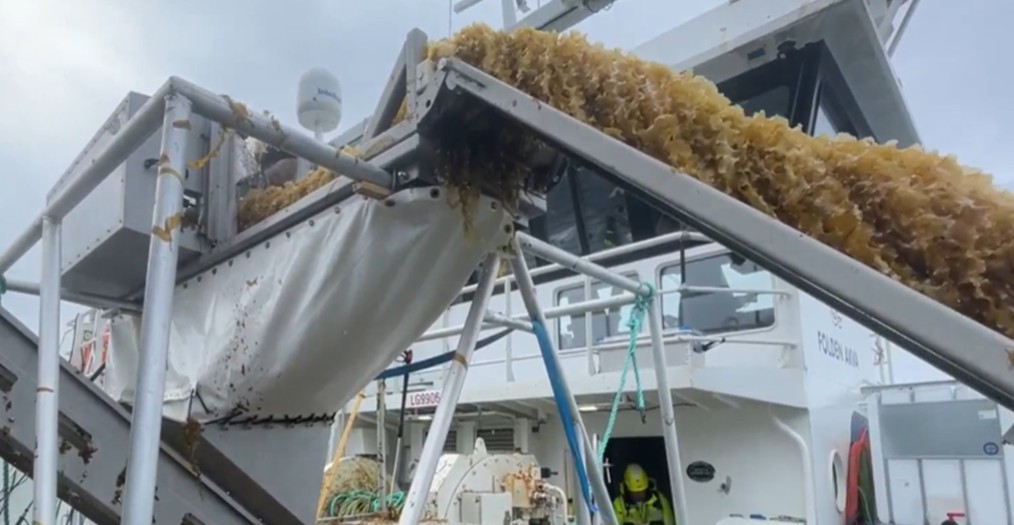
Notable cultivators, hatcheries & farming-technology developers
- Ocean Rainforest — Founded 2007; one of Europe's largest seaweed cultivators, growing Saccharina latissima and Alaria on roughly 220 hectares of longlines using a proprietary MacroAlgal Cultivation Rig built for offshore (>50 m depth) conditions.
- Cascadia Seaweed — Founded 2019; cultivates kelp across multiple British Columbia farm sites in partnership with coastal First Nations and processes it into agricultural biostimulants for North American markets.
- Atlantic Sea Farms — Founded 2019; supplies free kelp seed with a buy-back guarantee to a network of fishing families (largely Maine lobstermen), and represents the largest supply of farmed kelp in the United States.
- Hortimare — Dutch breeding and propagation specialist producing clean kelp gametophyte cultures and seedlings for direct-seeding and twine cultivation, supplying farmers and researchers worldwide.
- Seaweed Solutions AS — Founded 2009; operates one of Europe's largest seaweed nurseries and a flagship sugar-kelp (Saccharina) farm off Froya, Norway, producing more than 3 million kg of fresh biomass annually.
- AtSeaNova (formerly At-Sea Technologies) — Provides turnkey seaweed-farming systems and a proprietary AlgaeBinder direct-seeding method that glues juvenile brown and green seaweeds onto textile substrates, bypassing the hatchery twine step.
- Sea6 Energy — Founded 2010; developed the mechanized SeaCombine catamaran that simultaneously harvests and replants tropical seaweed, and launched a large-scale mechanized tropical seaweed farm off Lombok, Indonesia.
- Kelp Blue — Netherlands-founded company holding a 15-year licence to cultivate giant kelp (Macrocystis pyrifera) on submerged structures across a 6,400-hectare offshore site off Luderitz, producing biostimulants and other products.
- Seakura — Founded 2006; grows Ulva (sea lettuce) and Gracilaria year-round in land-based seawater pools fed by filtered deep seawater, producing food-grade seaweed biomass.
- Pure Algae Denmark — Founded 2018; develops modular land-based bioreactor systems, integrated with recirculating aquaculture, to grow sea lettuce (Ulva) while capturing CO2 and nitrogen from fish-farm effluent.
- GreenWave — US nonprofit co-founded in 2014 by Bren Smith and Emily Stengel promoting 'regenerative ocean farming' (3D vertical kelp-and-shellfish systems) through farmer training, tools and seed support.
- Zanzibar / Tanzania smallholder seaweed farming — East Africa's main seaweed-producing region, where over 25,000 mostly-women farmers grow red algae (Eucheuma denticulatum, Kappaphycus alvarezii) using the off-bottom peg-and-line method, largely for carrageenan export.
2 · Harvesting, stabilisation, processing & biorefinery (midstream)
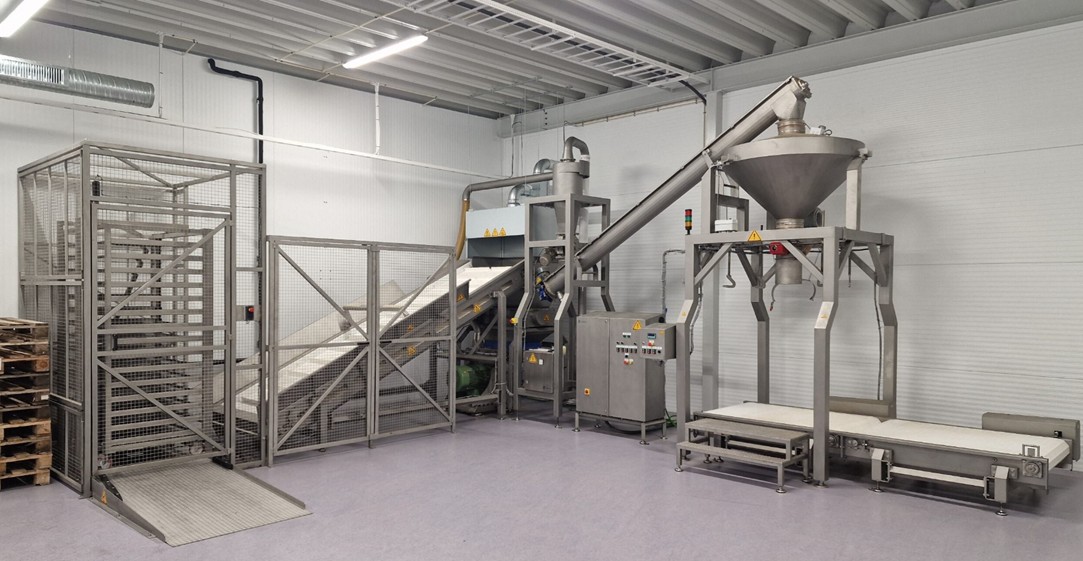
The midstream of the seaweed value chain converts harvested wet biomass into stable intermediates and finished ingredients through a sequence of unit operations: harvesting (by hand, dredge or mechanised harvester), washing and desalination, dewatering and pressing, drying, milling, extraction (of hydrocolloids such as agar, alginate and carrageenan, or of proteins, lipids and bioactives), and stabilization or preservation. Because fresh seaweed is 75-90% water, dewatering and drying dominate the energy budget of processing, and moisture reduction is the central engineering challenge; a multi-product "biorefinery" model that cascades several value streams from one harvest is the emerging design goal. A defining feature of this segment is that few purpose-built, off-the-shelf seaweed processing machines exist: most operators adapt generic food, dairy, wastewater and chemical equipment (decanter and disc-stack centrifuges, presses, spray and drum dryers, homogenizers, extractors) supplied by general engineering firms. The established seaweed-specialist actors are largely the legacy hydrocolloid producers (carrageenan, alginate, agar) plus a newer wave of biorefinery ventures, several of which build their own equipment in-house because commercial alternatives are lacking. This gap between abundant biomass and scarce dedicated processing technology is widely noted as a structural constraint on the industry.
Generic process-equipment suppliers (adapted to seaweed)
- Alfa Laval — Global separation and heat-transfer engineering firm; decanter and disc-stack centrifuges, separators and dryers are adapted for algae/seaweed dewatering and clarification.
- GEA Group — Process-engineering supplier of separators, decanters, homogenizers and spray dryers; states it has supported algae producers with processing technology for around 50 years.
- ANDRITZ — Separation and drying technology group offering decanter centrifuges plus integrated thickening, dewatering and drum-drying lines used for biomass and food streams.
- Flottweg — Manufacturer of decanter centrifuges and separators for solid-liquid separation across food, beverage and biomass applications.
- Bucher Unipektin — Maker of hydraulic press systems (HPS/HPX) and vacuum-drying plants for mechanical solid-liquid separation of fruit, juice and biosolids.
Seaweed-focused processing & biorefinery developers
- Acadian Seaplants — Vertically integrated brown-seaweed processor that engineers much of its own processing equipment because commercial seaweed machinery is scarce.
- Origin by Ocean — Biorefinery company developing an industrial-scale plant (planned Kokkola, Finland) to process Sargassum seaweed into alginate, fucoidan and other ingredients.
- Algaia — Alginate producer (part of JRS Group since 2023) operating a Normandy R&D centre and pilot biorefinery for co-extraction of alginates and fucoidans.
- Ocean Rainforest — Macroalgae cultivator and processor covering the chain from farming to value-added products; runs primary-processing R&D on storage and extraction methods.
- Sea6 Energy — Tropical-seaweed company that built the mechanised 'SeaCombine' harvester and pursues seaweed biorefinery products (biostimulants, feed additives, bioplastics).
- Marine Biopolymers Ltd (MBL) — Scottish developer of seaweed biorefining technology aimed at converting alginate plants into multi-product, low-waste seaweed biorefineries.
- CP Kelco (Tate & Lyle) — Long-established hydrocolloid producer extracting carrageenan from red seaweed; opened a new seaweed processing plant in southern India in 2025.
- IFF (formerly DuPont Nutrition & Biosciences) — Ingredient group described as the world's largest alginate producer, extracting alginate from wild-harvested brown seaweed.
Where SIRPUTIS fits
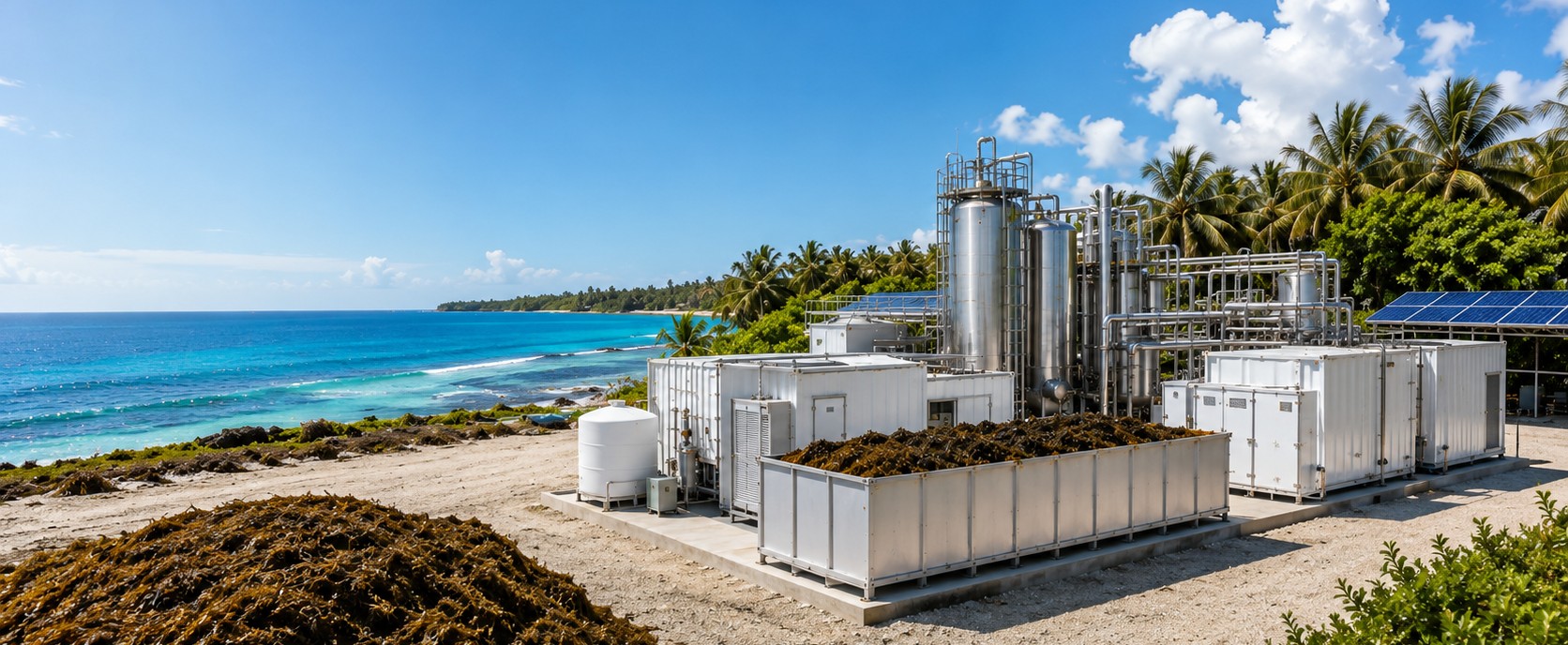
SIRPUTIS sits squarely in this midstream node. We design and build seaweed processing equipment and modular biorefineries — from single screw presses and dewatering lines to complete, Arctic-proven plants — together with species-specific processing protocols and quality and traceability systems. Our role is to convert cultivated or harvested seaweed into stable, buyer-ready outputs, whether as containerised modular units for pilot and distributed coastal sites or as larger fixed biorefineries.
Seaweed processing equipment · Complete processing lines · Modular biorefinery guide
3 · Products & applications (downstream)
The downstream of the seaweed value chain converts raw macroalgae into higher-value products. The oldest and largest established segment is hydrocolloids, the gelling and thickening polysaccharides alginate (from brown seaweeds), agar and carrageenan (from red seaweeds), which are extracted by a concentrated set of global ingredient firms and used across food, pharmaceuticals, cosmetics and industrial applications. Newer, fast-growing segments include Asparagopsis-based feed additives that suppress enteric methane in ruminants, seaweed-extract biostimulants for agriculture, and seaweed-based bioplastics and packaging aimed at replacing single-use plastics. Cosmetics and nutraceutical uses draw on bioactives such as fucoidan and other seaweed extracts. Several companies now pursue a "biorefinery" model that fractionates a single feedstock into multiple co-products (for example hydrocolloids plus fucoidan plus residual biomass).
Hydrocolloids — alginate, agar & carrageenan
- Cargill — Global food-ingredient producer of carrageenan and alginate texturizing systems extracted from red and brown seaweeds.
- IFF (International Flavors & Fragrances) — Produces carrageenan and related seaweed hydrocolloids; absorbed DuPont Nutrition & Biosciences and legacy FMC BioPolymer alginate/carrageenan lines.
- CP Kelco — Major producer of carrageenan and other hydrocolloids (also gellan gum, pectin).
- Marine Biopolymers Ltd (MBL) — Specialist in high-purity, molecular-weight-controlled alginates for life sciences, using a patented low-waste seaweed biorefinery process.
- Qingdao Gather Great Ocean Algae Industry Group (GGOG) — Large Chinese producer of sodium alginate, carrageenan, agar, propylene glycol alginate and alginate-based pharmaceutical excipients.
- Gelymar — Carrageenan producer drawing on Chilean red seaweeds, supplying food and other industries.
- Algaia — Produces alginates and other brown-seaweed extracts at a Lannilis facility with 50+ years of extraction history; also markets biostimulants.
Methane-reducing animal feed (Asparagopsis)
- FutureFeed — CSIRO-founded holder of global intellectual property for using Asparagopsis seaweed as a livestock feed ingredient to reduce enteric methane; licenses producers.
- Sea Forest — Cultivates Asparagopsis and manufactures the SeaFeed methane-reducing supplement for cattle, sheep and other ruminants.
- Blue Ocean Barns — Land-based grower of Asparagopsis; sells Brominata, a cattle feed additive with US GRAS status, produced at USDA-certified organic facilities.
- Symbrosia — Produces SeaGraze, an Asparagopsis taxiformis feed additive to reduce livestock methane emissions.
- CH4 Global — First company licensed by FutureFeed; grows Asparagopsis in land-based vessels and sells the Methane Tamer supplement.
- Rumin8 — Produces a synthesised version of the Asparagopsis anti-methanogenic bioactive (bromoform analogue) in liquid, solid and slow-release formats.
Agricultural biostimulants
- Acadian Plant Health (Acadian Seaplants) — Produces Ascophyllum nodosum seaweed-extract biostimulants (e.g. Stimplex) for crop growth, stress tolerance and yield.
- BASF (BioSolutions) — Markets seaweed-derived agricultural biostimulants within its crop BioSolutions portfolio.
Bioplastics & packaging
- Notpla — Makes seaweed-and-plant packaging including Ooho edible liquid pods, coatings, films, sachets and rigid tableware.
- Loliware — Develops seaweed-based resins and pellets ('SEA Technology') to replace single-use plastics such as straws and utensils.
- B'ZEOS — Develops seaweed-based biopolymer pellets and home-compostable single-use packaging.
- Origin by Ocean — Biorefines invasive sargassum brown algae into alginate, fucoidan and biomass residue for cosmetics, personal care, food and textiles.
Food, cosmetics & nutraceuticals
- Ocean's Balance — Supplier of certified-organic seaweed food ingredients (purees, flakes, meat-extension blends) for food, beverage, pet food and nutraceutical use.
- Marinova — Manufactures high-purity fucoidan extracts (Maritech range) from brown seaweed for skincare, nutricosmetics and dietary supplements.
Critical factors for developing the industry
Producing 37.8 million tonnes a year is not the same as building a mature, global industry. Analyses by the FAO, the World Bank and European bodies point to a consistent set of enablers and bottlenecks that decide how fast, and how sustainably, seaweed can scale beyond its Asian heartland. These are the factors that matter most.
Seedling & hatchery supply
Reliable, affordable seed and nursery capacity is the first constraint on scaling cultivation. Without dependable seedstock, farms cannot expand or diversify species.
Mechanised cultivation & harvesting
Outside Asia much farming is still manual and labour-intensive. Farm mechanisation, offshore systems and better gear are needed to reach cost-competitive scale.
Processing & dewatering capacity
The midstream gap: fresh seaweed is 75–90% water, bulky and seasonal, so purpose-built, species-specific processing near the coast is what turns biomass into value — the layer this guide focuses on.
Biosecurity, disease & climate resilience
Pests, epiphytes and warming, changing waters threaten yields. Resilient strains, disease management and monitoring underpin a stable supply.
Standards, certification & food safety
Harmonised standards for heavy metals, iodine, contaminants and traceability unlock premium food and export markets and build buyer trust.
Market & product development
Demand must be built beyond traditional hydrocolloids — in feed additives, biostimulants, food and materials. Secured offtake de-risks farming and processing alike.
Finance & bankability
First-of-a-kind farms and plants need blended and development finance, and bankable business cases, to cross from pilot to commercial scale.
Enabling policy & marine spatial planning
Licensing, permitting and coastal space allocation set the pace at which new producing regions can grow responsibly.
The value of collaboration across the chain
Seaweed is often drawn as a straight line, but its parts only reach their potential when they work as a system. A farmer with no nearby processor is left selling low-value wet biomass; a processor with no reliable supply cannot run a plant; a brand with no traceable, certified material cannot build a product. When cultivation, processing, product development, research, standards and finance connect, the whole chain becomes more valuable, and less risky, than the sum of its parts.
The gains from a joined-up chain are concrete rather than abstract:
- Value stays in producing regions — When cultivation, processing and product-making connect locally, more of the final value is retained in coastal economies instead of leaving as raw, low-value biomass.
- Traceability end to end — A joined-up chain can carry quality, origin and sustainability data from farm to buyer — increasingly required by food, feed and cosmetics markets.
- Shared R&D and faster learning — Farmers, processors, product developers and research institutions solve problems once and diffuse them across the chain, compounding progress.
- De-risked, bankable investment — Linking supply (farms) with offtake (processors and brands) turns fragmented projects into financeable systems.
- Resilient coastal communities — Farming and processing create local jobs — in many regions largely for women — and diversify incomes alongside fisheries and tourism.
The global seaweed ecosystem
Research & innovation
Universities and research institutes underpin the whole chain, from strain breeding and cultivation science to extraction chemistry and food safety. Below is a selection of leading groups by region; SIRPUTIS also maintains a fuller working directory of 280+ seaweed-active institutions worldwide.
Nordic (NO/IS/FO)
- SINTEF Ocean (Norwegian Seaweed Centre / SFI Seaweed) Norway
- Møreforsking, Ålesund Norway
- Ocean Rainforest SPF Faroe Islands
- TARI – Faroe Seaweed (with University of the Faroe Islands / Fróðskaparsetur Føroya) Faroe Islands
- Greenland Institute of Natural Resources (Pinngortitaleriffik) – incl. Greenland Climate Research Centre Greenland
- Matís ohf. (Icelandic Food and Biotech R&D) Iceland
Scandinavia & Baltics
- Aarhus University Denmark
- Technical University of Denmark (DTU) Denmark
- Tallinn University (TLU) Estonia
- University of Turku Finland
UK & Ireland
- Scottish Association for Marine Science (SAMS) — leads GlobalSeaweedSTAR Scotland, UK
- Teagasc – Food Research Centre, Ashtown, Dublin (Agriculture & Food Development Authority) Ireland
- Trinity College Dublin (TCD) Ireland
- University College Cork (UCC) – School of BEES Ireland
- University of Galway (NUI Galway) – Ryan Institute Ireland
FR / NL / BE / DE
Iberia & Mediterranean
US & Canada
Latin America
Asia (E/SE/S)
Oceania & Africa
- Flinders University Australia
- University of Adelaide Australia
- University of Tasmania (UTAS) Australia
- University of Technology Sydney (UTS) Australia
Industry networks, NGOs & knowledge platforms
A dense layer of networks, coalitions, NGOs and knowledge platforms has formed around the global seaweed value chain over the past decade, most of it concentrated in Europe and around UN-linked initiatives. These bodies broadly split into three roles: policy and market-building coalitions (EU4Algae, Seaweed for Europe, SUBMARINER Network), safety, science and standards bodies (the Safe/Global Seaweed Coalition, GlobalSeaweedSTAR, the International Seaweed Association), and knowledge, data and investment platforms (Phyconomy, Hatch Blue, and the US National Seaweed Hub). Several large funders and conservation NGOs, notably Lloyd's Register Foundation and The Nature Conservancy, underwrite or shape the sector's safety and environmental agenda. Commercial pioneers such as Ocean Rainforest also anchor collaborative R&D initiatives, blurring the line between company and network. Collectively these organisations supply the standards, data, funding and advocacy that a still-young industry relies on.
- EU4Algae — European Commission stakeholder platform (launched 2022) to accelerate a sustainable EU algae sector, offering a knowledge library, business corner and an algae farmers' toolkit to ~1,200 stakeholders.
- Safe Seaweed Coalition (now Global Seaweed Coalition, GSC) — Global multi-stakeholder coalition launched March 2021 by Lloyd's Register Foundation, the UN Global Compact and France's CNRS to build a safe, sustainable and scalable seaweed industry; rebranded as the Global Seaweed Coalition, hosted by the UN Global Compact.
- GlobalSeaweedSTAR (GCRF GlobalSeaweedSTAR) — UK Research and Innovation (GCRF) funded, ~51-month research programme led by SAMS / University of the Highlands and Islands addressing biosecurity, disease and sustainable growth in seaweed-producing developing countries; outputs include a digital atlas of seaweed diseases and pests.
- SUBMARINER Network for Blue Growth EEIG — Membership network promoting sustainable and innovative uses of marine resources, incl. seaweed and algae; a flagship of the EU Strategy for the Baltic Sea Region that develops partnerships and projects across research, industry, civil society and authorities.
- Seaweed for Europe — Coalition of 70+ members (farmers, processors, investors, research institutions, banks and civil society) working to scale a sustainable European seaweed industry through innovation and investment; publisher of influential market-potential reports.
- Phyconomy — Open-access, open-source platform tracking the seaweed economy since 2020: a database of 1,000+ companies, organisations and investors plus coverage of funding rounds, grants and research institutes, and regular state-of-the-industry analysis.
- International Seaweed Association (ISA) — International body connecting seaweed industry and academia, dedicated to research and development of seaweed and seaweed products; organiser of the triennial International Seaweed Symposium (ISS) held since 1953.
- National Seaweed Hub — A science-based, non-advocacy clearinghouse for the US seaweed aquaculture industry, run as a collaborative of ~12 NOAA Sea Grant programs; provides resources on seed sources, food-safety regulations, marketing and tissue testing.
- Ocean Rainforest — Faroese open-ocean seaweed (Saccharina latissima) cultivation and processing company founded in 2007; a partner and anchor participant in EU and international R&D initiatives (e.g. AquaVitae, North Sea Farmers / European seaweed community) and restorative-aquaculture work.
- The Nature Conservancy (restorative aquaculture / seaweed work) — Global conservation NGO that defined and promotes 'restorative aquaculture', using seaweed and bivalve farming to deliver net-positive environmental outcomes; funds and publishes research on the habitat and biodiversity benefits of kelp and shellfish farms.
- Lloyd's Register Foundation — UK charitable foundation focused on engineering-related safety; a founding funder and partner of the Safe Seaweed Coalition, financing work on consumer, environmental and operational safety standards across the seaweed value chain.
- Hatch Blue — Aquaculture-focused business accelerator and venture fund investing in sustainable aquaculture and seaweed technology ventures; runs an accelerator programme and funds, with a portfolio built past USD 100 million.
Industry & national associations
Alongside those networks, a growing layer of industry and interest associations represents seaweed farmers, processors and producers at national, regional and global level — from the Global Seaweed Coalition and Marinalg International down to national grower bodies.
- Global Seaweed Coalition (formerly Safe Seaweed Coalition) Global — Global partnership (Lloyd's Register Foundation, UN Global Compact, CNRS) uniting the seaweed value chain around safety and sustainability; hosts the UN Global Seaweed Initiative.
- Seaweed for Europe Europe — Coalition of 70+ members (farmers, processors, research, finance, civil society) working to accelerate a sustainable European seaweed industry.
- EU4Algae (European Algae Stakeholder Platform) European Union — European Commission stakeholder platform connecting algae farmers, producers, businesses and authorities to grow the EU algae industry (part of Farm to Fork).
- European Seaweed Association (ESWA, formerly North Sea Farmers) Europe — Membership industry association (130+ members) representing the European seaweed industry through EU advocacy, networking and promotion; based in The Hague.
- European Algae Biomass Association (EABA) Europe — Membership association (210+ members from 43 countries) promoting cooperation across the micro- and macro-algae sector; headquartered in Florence.
- Marinalg International (World Association of Seaweed Processors) Global — Global industry association of seaweed-derived hydrocolloid (agar, carrageenan, alginate) producers; represents the sector before Codex, EFSA and FDA.
- International Seaweed Association (ISA) Global — International membership association connecting seaweed industry and academia stakeholders; focused on encouraging seaweed research and development.
- Norwegian Seaweed Association / Norwegian Seaweed Cluster (Norsk Tang og Tare) Norway — National network of ~25 Norwegian seaweed cultivators, producers and knowledge firms; runs the Norwegian Seaweed Cluster (norseaweed.no) it owns.
- Danish Seaweed Organisation Denmark — Danish/Nordic industry association of ~14 seaweed members (harvesters to product makers); hosts Nordic seaweed conferences.
- Scottish Seaweed Industry Association (Seaweed Scotland / SSIA) Scotland (UK) — Membership organisation for Scotland's seaweed farmers, nurseries, harvesters and product makers, championing farmed and wild-harvested industries.
- UK Seaweed Network United Kingdom — UK-wide network (launched 2024/25 via UCL, Seaweed Scotland, UK Agri-Tech Centre, WWF-UK, Fishmongers' Company) championing the UK seaweed sector.
- Seaweed Forum Wales (SFW) Wales (UK) — Not-for-profit apex body linking government, education, industry and research to develop a cultivated seaweed industry in Wales.
- Irish Seaweed Association (ISA) Ireland — National seaweed industry association launched Feb 2025 (spun out of EU C-FAARER project, hosted at Trinity College Dublin); modelled on the Norwegian association.
- Chambre Syndicale des Algues et Vegetaux Marins (CSAVM) France (Brittany) — French professional trade syndicate for seaweed and marine plants, based in Brest, Brittany.
- Aotearoa New Zealand Seaweed Association (ANZSA) New Zealand — National membership association providing a united voice for a high-value, nature-positive New Zealand seaweed industry.
- Australian Sustainable Seaweed Alliance (ASSA) Australia — National trade body (~80 members) providing a coordinated voice to government and media for the Australian seaweed industry.
- Pacific Seaweed Association (Pacific Seaweed Industry Association) Canada (British Columbia) — Member-driven industry association acting as a unified voice for the Pacific/BC seaweed sector, working with Indigenous partners and government.
- Maine Seaweed Council United States (Maine) — Association formed in 1993 of seaweed harvesters, businesses and researchers promoting sustainable Maine seaweed harvest and cultivation.
- Seaweed Industry Association (SIA) United States / International — Seattle-based international trade association helping commercial seaweed members expand sales and publishing seaweed market reports.
- ASTRULI (Indonesian Seaweed Industry Association) Indonesia — Association of Indonesian seaweed processors/derivative manufacturers (carrageenan and agar) promoting sustainable, competitive industry development.
- COPRAM (Asociacion Gremial de Procesadores y Productores de Algas Marinas de Chile) Chile — Chilean trade association (asociacion gremial) representing marine-algae processors and producers and promoting sustainable sector development.
- Seaweed Association of South Africa (Seaweed South Africa) South Africa — Association aiming to bridge scientific research and commercial application in the South African seaweed industry (site seaweedsouthafrica.com did not resolve when checked).
- Asosiasi Rumput Laut Indonesia (ARLI) – Indonesian Seaweed Association Indonesia — National seaweed industry and producers association (founded 1989); extraordinary member of Indonesia's KADIN chamber of commerce.
- Zanzibar Seaweed Cluster Initiative (ZaSCI) Tanzania (Zanzibar) — Triple-helix cluster linking seaweed farmer groups, small processors and exporters with academia and government in Zanzibar; site seaweedcluster.or.tz did not resolve on verification.
- Pacific Seaweed Industry Association (PSA) Canada — Non-profit, member-driven association building a national seaweed network across Canada (based in Port Alberni, BC).
- Alaska Mariculture Alliance USA (Alaska) — Statewide industry alliance (~130 members) promoting shellfish and seaweed/kelp mariculture in Alaska.
Standards, certification & food safety
The seaweed value chain is governed by a still-maturing patchwork of voluntary certification schemes, EU and national regulation, and international standard-setting. Sustainability and social-responsibility claims are addressed mainly by the joint ASC-MSC Seaweed (Algae) Standard and, for organic claims, by EU Regulation (EU) 2018/848, which sets dedicated rules for wild collection and cultivation of algae. On policy, the European Commission's 2022 Communication "Towards a strong and sustainable EU algae sector" set out 23 actions to scale the industry, while FAO (through GLOBEFISH) supplies the market and production intelligence underpinning global trade. Food safety is the most active and least harmonised area: EU maximum levels for contaminants exist only partially for seaweed (notably cadmium in seaweed-based food supplements under Regulation (EU) 2023/915), so several member states such as France apply national limits, and EFSA and the FAO/WHO Codex Alimentarius are working to close the gaps on inorganic arsenic, cadmium and iodine. As of 2026 a global Codex group standard for seaweed is under development, signalling that international harmonisation is coming but not yet in force.
- ASC-MSC Seaweed (Algae) Standard — First joint standard from the Aquaculture Stewardship Council and Marine Stewardship Council for environmentally sustainable and socially responsible seaweed; released 22 Nov 2017, effective 1 March 2018, covering both wild harvest and cultivation, marine and freshwater, macro- and microalgae.
- EU organic production rules for algae — Regulation (EU) 2018/848 — EU organic regulation that defines dedicated production rules for algae, covering both collection of wild natural stocks and cultivation, including nutrient sourcing (e.g. IMTA), density/environmental-integrity requirements and a conversion period, as the legal basis for 'organic' seaweed labelling in the EU.
- EU Algae Initiative — Communication 'Towards a strong and sustainable EU algae sector' (COM(2022) 592) — European Commission Communication adopted 15 Nov 2022 setting out 23 actions to develop the EU algae industry across production, market development, food-safety knowledge and innovation; the first EU policy initiative dedicated specifically to algae.
- FAO GLOBEFISH — FAO's fisheries and aquaculture market-information programme; publishes the Globefish Research Programme (incl. Vol. 124, 'The global status of seaweed production, trade and utilization') and, from Feb 2026, a Quarterly Seaweed Analysis tracking global production, trade and prices.
- Codex Alimentarius (FAO/WHO) — Joint FAO/WHO body setting international food standards; its General Standard for Contaminants and Toxins in Food and Feed (CXS 193-1995) is the reference framework, and as of 2026 a Codex Committee on Fish and Fishery Products electronic working group (Brazil chair, France co-chair) is developing a dedicated global group standard for seaweed.
- European Food Safety Authority (EFSA) — EU risk-assessment body whose opinions underpin contaminant limits; established a tolerable upper intake level for iodine of 600 µg/day for adults, and in 2023 assessed EU dietary exposure to heavy metals (cadmium, lead, mercury, inorganic arsenic) and iodine via seaweed and halophyte consumption.
- EU maximum contaminant levels — Commission Regulation (EU) 2023/915 — EU regulation on maximum levels of contaminants in food (applicable since 25 May 2023, repealing Reg. 1881/2006); sets a cadmium maximum of 3.0 mg/kg for food supplements consisting mainly of dried seaweed or seaweed-derived products. No EU-wide maximum levels yet exist for cadmium, lead or inorganic arsenic in seaweed sold as food itself.
- ANSES / French national limits for edible seaweed — France sets national maximum levels for edible seaweed used as vegetable/condiment: inorganic arsenic 3 mg/kg, cadmium 0.5 mg/kg (CSHPF recommendation), mercury 0.1 mg/kg and lead 5 mg/kg (dry weight); ANSES has since recommended a stricter cadmium limit of 0.35 mg/kg dry weight to reduce exposure.
Funding & investment landscape
Financing for seaweed and the wider "blue economy" comes from two broad, complementary sources. Public programs supply grants, co-funding and risk capital: at EU level these include Horizon Europe (research and innovation), Eurostars (SME-led R&D), the European Maritime, Fisheries and Aquaculture Fund (EMFAF) and the BlueInvest access-to-finance initiative, while globally the World Bank's PROBLUE trust fund and various national and bilateral blue-economy grant schemes co-finance projects and capacity building. Alongside these, a category of private capital has formed around the ocean: impact and "ocean" venture funds, natural-capital strategies from large asset managers, and specialised accelerators that combine seed investment with mentoring. This private capital generally targets aquaculture, ocean biodiversity, circularity and marine-technology startups rather than seaweed exclusively, and returns and mandates vary widely by fund. The entries below describe each program or fund by its public role and are for reference only; inclusion implies no relationship with or endorsement of any specific company.
- Horizon Europe — The EU's 2021-2027 research and innovation framework programme (budget EUR 95.5 billion) that funds collaborative R&I including marine, aquaculture and bioeconomy topics.
- Eurostars (Eureka) — SME-led collaborative R&D funding programme run under the Eureka network and co-funded by the EU through Horizon Europe, supporting international consortia up to TRL 6.
- European Maritime, Fisheries and Aquaculture Fund (EMFAF) — The EU fund (budget EUR 6.108 billion, 2021-2027) supporting the Common Fisheries Policy, sustainable aquaculture and the wider blue economy via national programmes and direct EU management.
- BlueInvest — European Commission and European Investment Fund (EIF) initiative combining an equity fund-of-funds and an investment-readiness platform to channel risk capital to blue-economy SMEs and start-ups.
- World Bank PROBLUE — An umbrella multi-donor trust fund administered by the World Bank that supports integrated, sustainable development of ocean and coastal resources across fisheries/aquaculture, pollution, key ocean sectors and government capacity.
- EEA and Norway Grants – Blue Growth — An example of national/bilateral blue-economy grant schemes: under the EEA and Norway Grants, 'Blue Growth' programmes support business cooperation, innovation and competitiveness in marine and maritime sectors.
- Hatch Blue — An aquaculture-focused innovation and investment firm that runs an early-stage accelerator and manages venture funds across the sustainable-aquaculture and ocean value chain, including some seaweed-related investments.
- Katapult Ocean — An ocean-focused impact investor operating an accelerator programme and several ocean funds, backing technology startups across ocean food, energy, transport, circularity and data.
- SWEN Blue Ocean (SWEN Capital Partners) — An impact venture fund line dedicated to regenerating ocean biodiversity, investing in startups addressing overfishing, pollution and climate change; the manager also co-founded the '1000 Ocean Startups' ecosystem coalition.
- S2G / Builders Vision — A US impact-investing platform (Builders Vision) and its investment manager (S2G) that deploy capital into oceans and seafood alongside food/agriculture and energy; S2G launched an oceans and seafood investment strategy.
- AXA IM Alts – Natural Capital & Impact — An example of large asset managers entering natural capital: AXA IM Alts runs a natural-capital and impact strategy financing nature-based solutions and ecosystem-service projects.
Frequently asked questions
What is the seaweed value chain?
The seaweed (macroalgae) value chain is the full path from growing or harvesting seaweed to finished products: cultivation and seeding, harvesting, stabilisation and processing, biorefining and extraction, and finally products such as food, hydrocolloids, animal feed, biostimulants and biomaterials. Around it sits an ecosystem of research institutions, industry networks, NGOs, standards bodies and investors.
How big is the global seaweed industry?
Global algae output was about 37.8 million tonnes (wet weight) in 2022, roughly ~97% farmed (≈1.3 million tonnes wild-collected). The commercial market is estimated at about USD 9 to 10.5 billion, and the World Bank projects up to USD 11.8 billion in additional value from ten emerging application markets by 2030.
Which countries produce the most seaweed?
Production is highly concentrated in East and Southeast Asia, which account for roughly 97 to 98 percent of farmed volume. China is the largest producer (about 57 to 61 percent of world output) and Indonesia the second largest (roughly a quarter). Producers outside Asia, such as Chile, Tanzania/Zanzibar, Norway and the Faroe Islands, together make up under 2 percent.
What are the main stages of seaweed processing?
Processing turns wet biomass into stable, usable material through a sequence of unit operations: harvesting, washing and desalination, dewatering and pressing, drying, size reduction (milling), extraction (of hydrocolloids, proteins or bioactives) and stabilisation. Because fresh seaweed is 75 to 90 percent water, dewatering and drying dominate the energy and cost of processing.
What products are made from seaweed?
The largest established products are hydrocolloids (alginate, agar and carrageenan) used as gelling and thickening agents. Fast-growing segments include methane-reducing animal-feed additives (from Asparagopsis), agricultural biostimulants (already over a third of the biostimulant market), seaweed-based bioplastics and packaging, food ingredients, cosmetics and nutraceuticals.
Why is processing the bottleneck in the seaweed value chain?
Most seaweed processing today relies on generic food and chemical equipment adapted from other industries, with relatively few seaweed-specialist equipment and biorefinery builders. Seaweed is bulky, wet, salty and seasonal, so purpose-built, species-specific processing and dewatering technology is where much of the value and risk sits. This is the layer SIRPUTIS builds for.
Where does SIRPUTIS fit in the seaweed value chain?
SIRPUTIS sits in the midstream: it designs and builds seaweed processing equipment and modular biorefineries, from single screw presses to complete plants, plus species-specific processing protocols and quality/traceability systems. In other words, SIRPUTIS supplies the infrastructure that converts cultivated or harvested seaweed into buyer-ready outputs.
Building or scaling a seaweed plant?
SIRPUTIS designs and delivers the processing and biorefinery layer of this value chain — equipment, complete lines and modular plants, sized to your species and site.
Talk to our engineersSources & references
This guide draws on public data from the FAO, World Bank, UNCTAD, the European Commission, EFSA, peer-reviewed literature and the organisations named above. Key sources:
- www.fao.org — https://www.fao.org/3/cd0683en/online/sofia/2024/executive-summary.html
- www.fao.org — https://www.fao.org/newsroom/detail/sofia-2026–global-fisheries-and-aquaculture-production-reaches-new-highs/en
- www.worldbank.org — https://www.worldbank.org/en/news/press-release/2023/08/16/new-farmed-seaweed-markets-could-reach-11-8-billion-by-2030
- www.worldbank.org — https://www.worldbank.org/en/topic/environment/publication/global-seaweed-new-and-emerging-markets-report-2023
- seaweedinsights.com — https://seaweedinsights.com/global-production-overview
- www.tandfonline.com — https://www.tandfonline.com/doi/full/10.1080/09670262.2017.1365175
- unctad.org — https://unctad.org/system/files/official-document/ditcted2024d1_en.pdf
- www.grandviewresearch.com — https://www.grandviewresearch.com/industry-analysis/commercial-seaweed-market
- www.gminsights.com — https://www.gminsights.com/industry-analysis/commercial-seaweed-market
- www.fao.org — https://www.fao.org/newsroom/detail/fao-report-global-fisheries-and-aquaculture-production-reaches-a-new-record-high/en
- www.fao.org — https://www.fao.org/4/ac416e/ac416e00.htm
- thefishsite.com — https://thefishsite.com/articles/are-investors-in-the-seaweed-sector-looking-in-the-wrong-place-hatch-seaweed-insights
- www.globalseafood.org — https://www.globalseafood.org/advocate/for-seaweed-farmers-in-zanzibar-a-chance-for-real-growth/
- www.oceanrainforest.com — https://www.oceanrainforest.com
- www.cascadiaseaweed.com — https://www.cascadiaseaweed.com
- atlanticseafarms.com — https://atlanticseafarms.com
- hortimare.com — https://hortimare.com
- seaweedsolutions.com — https://seaweedsolutions.com
- atseanova.com — https://atseanova.com
- sea6energy.com — https://sea6energy.com
- www.kelp.blue — https://www.kelp.blue
- seakura.com — https://seakura.com
- www.purealgae.dk — https://www.purealgae.dk
- www.greenwave.org — https://www.greenwave.org
- www.acadianseaplants.com — https://www.acadianseaplants.com/engineering-seaweed-processing-technology/
- www.gea.com — https://www.gea.com/en/stories/game-changers-algae-industry/
- www.andritz.com — https://www.andritz.com/separation-en/products/decanter-centrifuges
- www.flottweg.com — https://www.flottweg.com/product-lines/decanter/
- www.bucherunipektin.com — https://www.bucherunipektin.com/products
- www.originbyocean.com — https://www.originbyocean.com/blog/origin-by-ocean-secures-strong-eu-backing-for-first-of-a-kind-industrial-scale-seaweed-biorefinery
- www.algaia.com — https://www.algaia.com/
- www.oceanrainforest.com — https://www.oceanrainforest.com/projects-overview
- www.sea6energy.com — https://www.sea6energy.com/mechanised-ocean-farming/
- www.marinebiopolymers.co.uk — https://www.marinebiopolymers.co.uk/index.html
- www.cpkelco.com — https://www.cpkelco.com/carrageenan/
- www.dupontnutritionandbiosciences.com — https://www.dupontnutritionandbiosciences.com/product-range/seaweed/alginate.html
- en.wikipedia.org — https://en.wikipedia.org/wiki/Seaweed_farming
- www.mdpi.com — https://www.mdpi.com/1660-3397/23/9/366
- pmc.ncbi.nlm.nih.gov — https://pmc.ncbi.nlm.nih.gov/articles/PMC6891440/
- www.sciencedirect.com — https://www.sciencedirect.com/science/article/pii/S2452223622001407